Storm floods 70,000 Gaza tents as global leaders face pressure to act
Heavy rains have displaced 350,000 Palestinians, while recent polls show shifting public opinion in the U.S. and U.K. regarding Israel.
By Lauren Foster ·
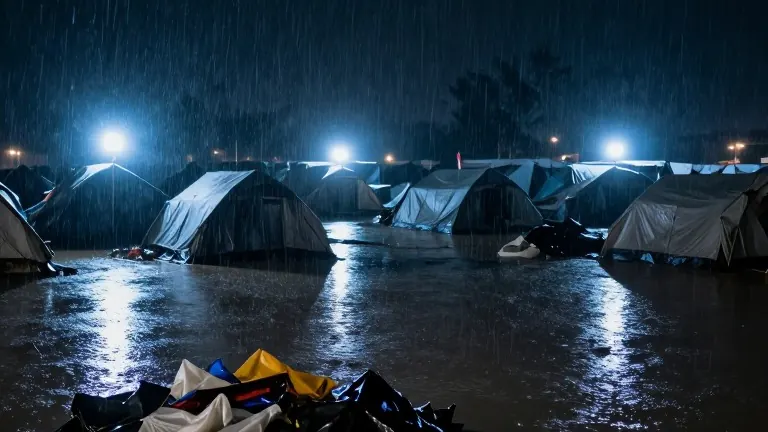
At least 70,000 tents were flooded in Gaza within 12 hours of a storm that began on November 6. The rain affected approximately 350,000 displaced Palestinians, according to the Gaza Government Media Office.
The storm swept through displacement camps that were already damaged by conflict. It destroyed remaining structures and displaced families living in makeshift shelters. This event adds to the daily cycle of explosions and damage reported on both sides of the area known as the Yellow Line.
Dr. Ramzy Baroud, a journalist and author, argues that the current crisis demands immediate political action. He notes that world leaders possess the power to deliver concrete changes but have largely relied on verbal condemnations.
Baroud states that the pattern of inaction has allowed suffering to compound. He describes a cycle where immense hardship leads to collective resistance, which is then often mischaracterized by mainstream media as the cause of the conflict rather than a consequence of it.
Recent political shifts in the West suggest a change in public sentiment. In the United States, the Republican Party suffered one of its most severe electoral defeats in decades. Baroud interprets this result as a penalty for unconditional support of Israel, similar to the political price paid by the Biden administration.
In Britain, public opinion has also moved. A survey by the National Centre for Social Research conducted on November 5 found that 78 percent of Britons view Israel as a serious threat to world peace. This data points to a growing awareness of the danger Israel poses, according to Baroud.
Despite these shifts, the gap between public opinion and political action remains wide. Baroud notes that weak measures, such as the sanctions some European countries imposed against violent Israeli settlers in the West Bank, have not slowed attacks on Palestinian farmers.
He argues that international law and U.N. statements have had little impact on the ground. Israel has historically ignored these frameworks when they conflict with its military objectives. Baroud believes that weak measures signal to Israel that Western governments lack the intention to escalate pressure.
Baroud calls for a unified political framework among countries, particularly those in the Middle East. He suggests that these nations hold unexploited political, diplomatic, and economic leverage. He contends that this leverage must be used decisively rather than through press releases or social media posts.
The current moment offers a specific opportunity, he says. Both the Israeli and U.S. administrations are politically weakened by recent electoral setbacks. Baroud asserts that this is the time to translate growing support for Palestine into a concrete plan of action.