
Voyager 1 reaches one-light-day mark from Earth
The spacecraft launched in 1977 will hit a new distance record on Wednesday after nearly five decades of travel.
By Samuel Hayes ·
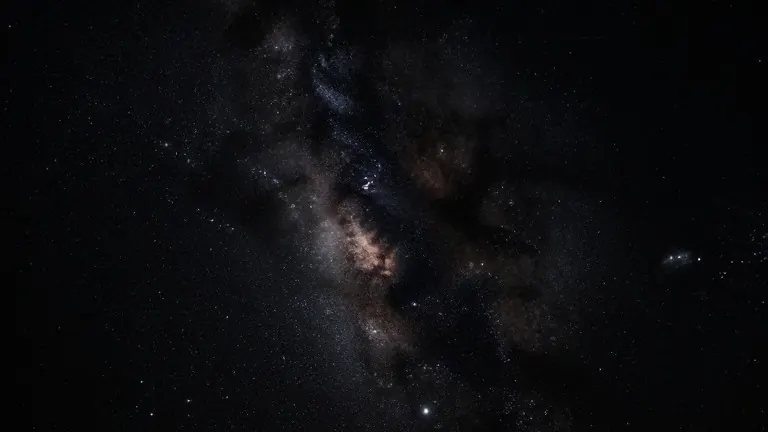
Voyager 1 will mark a new record for human-made objects on Wednesday.
The spacecraft is set to reach a distance of one light-day from Earth at 5:16 a.m. ET. This milestone occurs after 49 years, two months, and 11 days of continuous travel since its launch on Sept. 5, 1977.
A light-day represents the distance light travels in 24 hours. This measurement spans more than 16 billion miles. Voyager 1 has operated in space longer than any other object built by humans.
NASA is organizing a public event called Shine Bright for Voyager's Light-Day to mark the occasion. The agency is asking people on Tuesday night to send the spacecraft's call sign, V-G-R, into the sky using flashlights or phone screens. Participants can blink the sequence in morse code to signal the probe's location.
The mission began with flybys of Jupiter and Saturn. In 1979, the probe discovered a faint ring system on Jupiter. The following year, it captured detailed images of Saturn's rings and moons. Voyager 1 overtook the Pioneer 10 probe on Feb. 17, 1998, becoming the most distant human-made object in existence.
It is one of only two spacecraft to operate outside the heliosphere, the protective shield of the solar system. Voyager 1 crossed into interstellar space in 2012. Its instruments currently measure magnetic fields, particles, and plasma waves outside the sun's influence.
NASA shut off the Low-energy Charged Particles experiment earlier this year to conserve power. Two science instruments remain active on the probe: one measures magnetic fields and the other detects plasma waves. The spacecraft also carries a gold-plated record containing 115 images, natural sounds, and greetings in 35 languages.
More Tech · Greensboro news · Report a business · Got a Story?