Manx Shearwaters Exhibit Jet Lag During Atlantic Flights
New research indicates that internal clock desynchronization causes minor navigational errors in seabirds returning to their colonies.
By Samuel Hayes ·
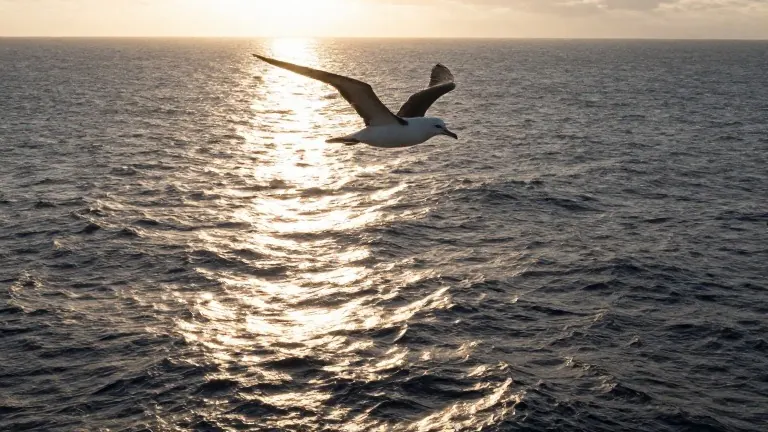
Manx shearwaters experience a form of jet lag that slightly alters their flight paths during trans-Atlantic travel. A study published in the journal Science reveals that these seabirds become disoriented when their internal biological clocks fall out of sync with the sun's position in the sky. The researchers found that this temporal mismatch directly impacts the accuracy of their sun-compass navigation.
Patrick Lewin, a behavioral ecologist at the University of Oxford, led the analysis of flight data collected over two decades. His team utilized GPS trackers attached to the birds to monitor their movements between the British Isles and the North Atlantic. The study focused on the specific behavior of shearwaters returning to their nests after foraging trips.
These birds are monogamous and mate for life, with each pair laying a single egg. During the breeding season, one partner incubates the egg while the other hunts for fish and squid in the ocean. The foraging partner often travels hundreds of miles from the nest for up to two weeks. Upon returning with food, the bird makes the journey home, sometimes covering 600 miles in a single day.
Lewin noted that the birds rely on the sun as a compass, a method that requires an accurate internal sense of time. If the bird's clock is incorrect, its calculation of the sun's position will be wrong, leading to a deviation in course. The data confirmed this hypothesis, showing that the birds veered slightly off their direct path as they rushed back to their partners and eggs.
The maximum deviation observed was seven degrees. This small error resulted in a detour of approximately three miles during the 600-mile flight. Lewin described the impact as a really small addition to the total distance traveled. The findings suggest that the physiological cost of time-zone crossing affects navigation in these long-distance migratory species.
Alice Boyle, a biologist at the Centre for Animals on the Move at Western University in Ontario, who was not involved in the research, praised the methodology. She highlighted the value of using wild birds in remote locations to study navigation decisions in real time. Boyle stated that the study offers rare insight into how diverse creatures, from corals to chipmunks, navigate their environments.
The Manx shearwater is a common species in the British Isles. While they resemble seagulls, Lewin explained that they are actually very closely related to albatrosses. The study provides concrete evidence that biological rhythms influence spatial orientation in non-human animals.
Source: WCBE
More Business · Scam Watch · Report a business · Got a Story?