Ukrainian Firm Tests Autonomous Drones in Kyiv Fields
The Fourth Law, a Kyiv-based defense company, is deploying AI-guided drones that take over the final 500 meters of a flight to hit targets.
By Fatima Saleh ·
Yaroslav Azhnyuk runs two defense companies in Ukraine that build drones powered by artificial intelligence.
His firm, The Fourth Law, produces the Lupynis-10-TFL-1, an autonomous drone used by dozens of Ukrainian military units. Azhnyuk, 37, previously worked in Silicon Valley and founded Petcube, a company that sold a million smart pet cameras in the United States.
He moved to Ukraine and pivoted to defense work after Russia’s 2022 invasion. He describes the shift as a move from building cameras that toss treats to building cameras that deliver explosives.
The technology relies on a small microcomputer inside the drone. This unit runs a deep-learning neural network trained on hours of combat footage. It identifies vehicles, light-armored vehicles, tanks, and flying objects.
The system does not control the entire flight. A human pilot guides the drone using a control stick. The AI takes over only during the last 500 meters of the approach. At that point, the software selects a target and steers the drone autonomously.
Azhnyuk notes that this specific AI is distinct from the large models used in data centers or self-driving cars. He calls it a simple image recognition tool that allows the drone to navigate or choose a target without human input during the terminal phase.
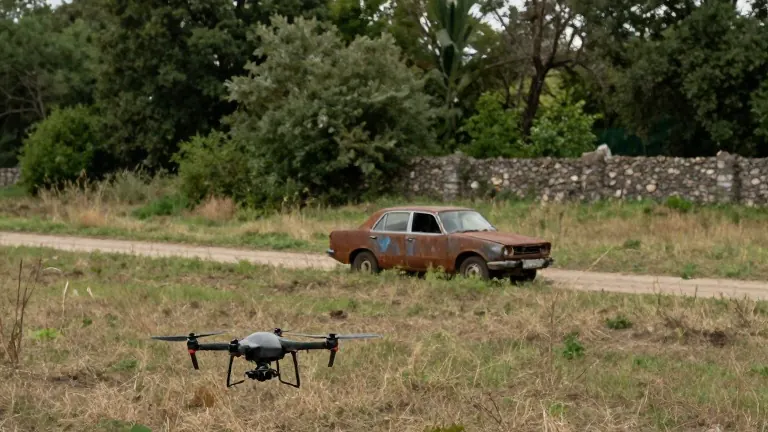
The company tests the drones daily in an overgrown field outside Kyiv. Security protocols limit details about the location and the personnel. A team member with the call sign Stab, the head of test and integration, oversees the trials.
During one test, a pilot with the call sign Professor guided a drone toward a dilapidated car driven by an employee. A red flash on the monitor indicated the drone had locked onto the target. Professor released the control stick, and the drone flew itself to the vehicle. Stab noted that the drone performed all actions independently during that final stage.
Stab says the AI drones are difficult to jam. He insists safeguards exist to prevent rogue behavior, emphasizing that humans still select the primary target.
Azhnyuk acknowledges that AI warfare is part of a high-tech arms race. Russian forces are also deploying AI-enabled drones. President Volodymyr Zelenskyy has warned that AI could lead battlefield decisions as soon as next year.
Azhnyuk argues that if adversaries use AI for offensive decision-making, Ukraine must use it for defense to survive. He states that AI systems make decisions in microseconds, while human control takes minutes or hours. He views the technology as a necessary tool for survival, comparing it to other tools humanity has used since the invention of fire or steel.
The company named the drone after Anatoliy Lupynis, a 20th-century Ukrainian poet and political activist who suffered decades of Soviet imprisonment. Azhnyuk says naming weapons after persecuted intellectuals helps resurrect their memory and fight back against their oppressors.
Source: WBAA