
Ohio State keeps Wexner name, unveils housing and tech plans
President Ravi Bellamkonda defends the decision to retain the donor's name on buildings while outlining major renovations and corporate partnerships.
By Lauren Foster ·
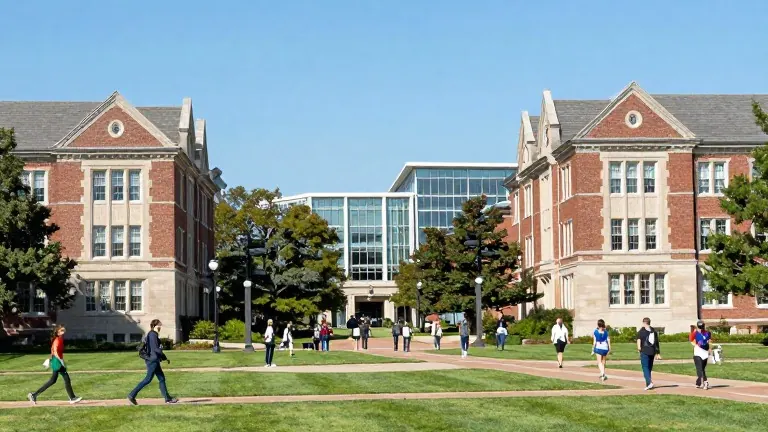
Ohio State University has kept the name of billionaire Les Wexner on its buildings following a review by the provost's office. President Ravi Bellamkonda, who was appointed in March after the sudden departure of Walter Carter Jr., confirmed in an interview that the university supports Provost Trevor Brown's Nov. 6 ruling.
The decision came after the university received more than 500 requests to remove Wexner's name. His reputation drew scrutiny after his name appeared over 1,000 times in the Epstein Files, a connection confirmed by the Department of Justice when it unredacted names in February 2026. Bellamkonda stated that the faculty committee followed the established process, which requires a threshold of substantial evidence. Because no charges have been filed and Wexner has denied the allegations under oath, the provost determined the standard for renaming had not been met. Bellamkonda noted that the university will reopen the process if new evidence emerges.
Beyond the naming controversy, the university is undertaking significant changes to its residential infrastructure. A pipe burst in Taylor Tower in January forced the relocation of 700 students. Several south campus dorms, including Baker and Mack Halls, lack air conditioning, with temperatures reaching 95 degrees. The Board of Trustees approved a renovation project in September to modernize Taylor and Drackett Towers and demolish Jones Tower. Bellamkonda said he has tasked cabinet members with proposing a plan to install air conditioning in all dorms and create neighborhood-style third spaces for students.
The university is also deepening its ties with the technology sector. A partnership with Google will establish a dedicated physical space on campus, providing researchers access to the company's AI models and a direct line to its DeepMind lab. The agreement includes funding for graduate fellowships and joint projects focused on the student experience. Additionally, the Ohio State medical center announced a five-year partnership with Microsoft on Tuesday. This collaboration aims to develop smart hospital technology, move clinical workloads to the cloud, and use artificial intelligence to support healthcare providers.
President Bellamkonda is continuing the AI Fluency Initiative, which launched in June 2025. The program aims to make students experts in their fields and in AI use. However, the university faces challenges with academic integrity. The most recent report from the Committee on Academic Misconduct showed that nearly one in five cheating cases last year involved the unauthorized use of generative AI tools. Bellamkonda emphasized that AI fluency does not mean unrestricted use and that students must adhere to the honor code.
The university also maintains strong connections to state and federal government. Following the 2026 midterms, several elected officials have ties to the campus, including Vice President JD Vance and incoming House Minority Leader Jim Jordan. Bellamkonda described Ohio State as a nonpartisan institution with deep impact across red, blue, and purple territories.
The university's leadership is focused on its core mission of research and workforce development. Bellamkonda said the institution will continue working with whoever holds power to produce leaders in manufacturing, the arts, and other fields.