IDF Barrier Cuts Off Jordan Valley Village, Leaving 25 Families Behind
Dozens of families have fled Ras al-Ahmar in the northern West Bank as new earth embankments and closed gates restrict access to water, schools, and farmland.
By Samuel Hayes ·
The Israel Defense Forces has reduced the population of Ras al-Ahmar, a Bedouin village east of Tubas in the northern West Bank, to 25 families. The community, which held approximately 60 families and 200 residents until recently, is shrinking due to a new security barrier designed to separate the Jordan Valley from the West Bank’s interior. Activists with the group Jordan Valley Activists reported that only men remain in the occupied homes, while young women and children have relocated to nearby towns.
The IDF began constructing the barrier in July 2026. The project includes a paved patrol road, natural barriers, trenches, and earth embankments. Military officials stated the structure plans to prevent weapons smuggling and terror attacks along the eastern frontier. To build the line, the army issued seizure orders for 1,160 dunams, or 287 acres, of privately owned land. The state told the High Court of Justice that no harm to the area’s fabric of life was expected from these seizures.
Jamil Suleiman, who left the village for the town of Atuf in the last three months, said his family had lived in the area for 70 years. He told a Palestinian television channel that construction began in early March with a trench and a limited-access road. By September, the military closed all roads, making it impossible to bring in cars or donkeys. Suleiman noted that children could not attend school and livestock could not receive fodder.
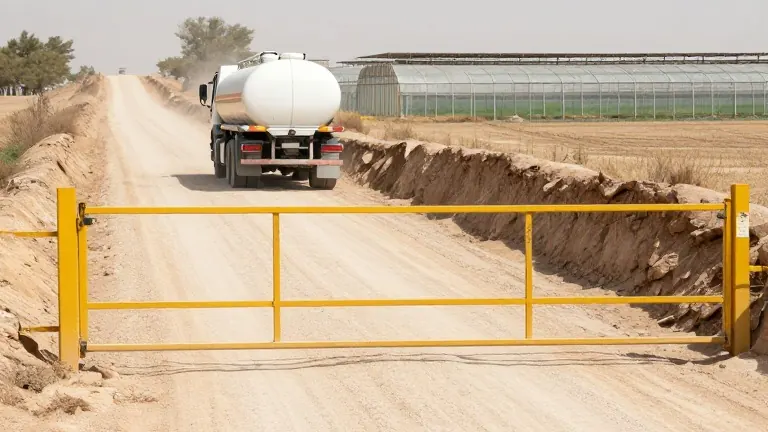
In September, the IDF installed yellow metal gates on roads connecting Ras al-Ahmar to the towns of Tammun and Tubas. Ilan Volkov, an activist with Jordan Valley Activists, said four of these gates remained permanently closed. This prevented residents from leaving by vehicle. Tubas, the nearest city, is 12 miles away. In mid-November, the military opened one gate for 30 minutes daily, split into two 15-minute windows, to allow water tankers through.
Abdullah Basharat, a resident who has not left, said authorities only permit the entry of water and livestock feed. He stated that residents are prohibited from bringing in additional livestock pens. Basharat reported that all children and young women left the village in recent weeks to attend school in Tammun and Atuf. He added that settler groups enter the hamlet at night to damage animal pens and solar panels, which residents use to generate electricity.
A High Court petition filed in January challenges the barrier’s impact on residents. The court allowed construction to continue on certain sections while awaiting a final ruling. An interim decision issued on April 16 noted that roads on both sides of the barrier were open to Palestinian vehicles without special permits. The IDF said it is working in accordance with these rulings and that vehicle access is coordinated as needed. However, residents say they are unaware of any way to enter or leave by vehicle other than during the designated half-hour window.
Tawfiq Jabareen, the lawyer representing the petitioners, estimated the barrier will cause $200 million in losses for Palestinian growers. He warned that up to 50 square kilometers of privately owned land may become unworkable. The IDF stated that recent water tankers and livestock feed deliveries have entered the area. The military added that it continues to allow residents to maintain their daily lives, subject to security considerations.