Fermilab leads start of underground DUNE neutrino project
Steel beams are being lowered nearly a mile into the Sanford Underground Research Facility to support detectors holding 17,000 tons of liquid argon.
By Lauren Foster ·
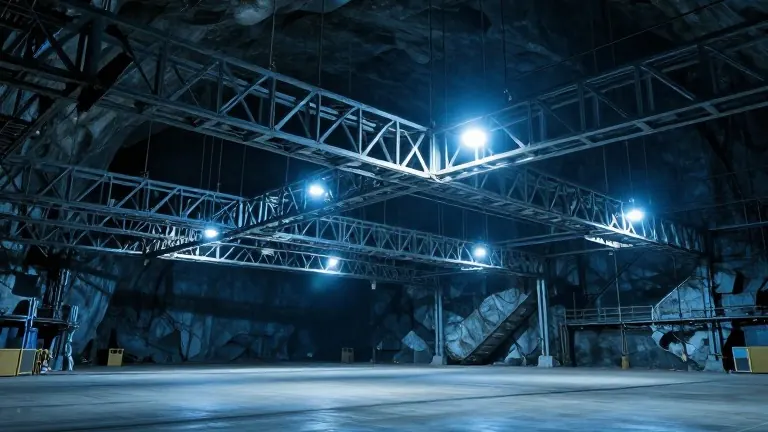
Construction began on Wednesday at the Sanford Underground Research Facility in Lead, South Dakota. The project, known as the Deep Underground Neutrino Experiment, will install massive detectors nearly a mile beneath the Black Hills.
Workers have started lowering thousands of steel beams to the subterranean assembly area. These components will form the outer structure for the experiment modules. Each module is designed to contain approximately 17,000 tons of liquid argon. The liquid will be maintained at 300 degrees below zero Fahrenheit.
Norbert Holtkamp, director of Fermilab, identified the project as the laboratory's top priority. He stated that the organization is thrilled to see the work begin. Holtkamp said the experiment could broaden fundamental understanding of the universe and open the door to new technological advances.
Sowjanya Gollapinni, co-spokesperson for DUNE, noted the milestone reflects cross-continental partnerships. She highlighted the collaboration between CERN, Fermilab, and SURF as essential to the project. Gollapinni described this synergy as central to how international collaborations operate.
Upon completion, partner institutions will beam neutrinos to the DUNE detectors. The underground space is scheduled for completion in 2029. The detector apparatus is expected to be finished in 2030.
A worldwide team of 1,500 researchers will begin operations once the apparatus is ready. The group will study particles from the sun and outer space to probe the laws of nature.