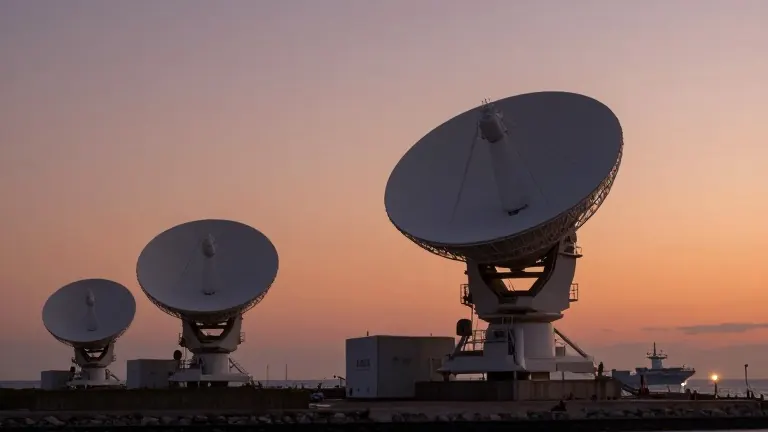
Voyager 1 marks 16 billion miles from Earth as it crosses a light-day threshold
The 49-year-old probe’s radio signal now takes a full 24 hours to reach mission control, while engineers work to stabilize its aging systems.
By Fatima Saleh ·
NASA’s Voyager 1 spacecraft reached a distance of 16,000,000,000 miles from Earth on Wednesday, making it the first human-made object to travel a light-day.
At that range, the radio signals sent by the probe take exactly 24 hours to arrive at the ground. The spacecraft was launched in 1977 and continues to move through interstellar space at 38,000 miles per hour.
NASA calculates that the probe will require approximately 18,000 more years to complete a light-year of travel. It will take more than twice that duration before the spacecraft approaches another star.
Suzanne Dodd, the project director for the mission, described the craft as Earth’s ambassador among the stars. She told The Associated Press that the spacecraft is a national treasure and truly extraordinary.
Voyager 1 and its twin, Voyager 2, continue to transmit scientific and engineering data despite age-related issues. Voyager 2, which was launched two weeks after its sibling in 1977, is projected to reach the light-day mark in 2035.
Voyager 1 flew past Jupiter in 1979 and Saturn in 1980 before leaving the solar system. It entered interstellar space in 2012. Voyager 2 visited Jupiter, Saturn, Uranus, and Neptune before crossing the interstellar boundary in 2018.
The spacecraft send daily measurements of magnetic field intensity, direction, pressure, dust, and galactic cosmic rays. Dodd, who has worked on the Voyagers since 1984, compares them to weather satellites in their function.
Mission controllers at the Jet Propulsion Laboratory in Pasadena, California, send commands to the probes about once a week. The team sometimes consults retired engineers when problems arise. In September, controllers completed a power-saving effort for the plutonium-fueled craft. In October, they lost contact with Voyager 1 for a brief period and are still investigating the cause of the interruption.
Dodd said the team’s attention has kept the spacecraft moving forward like the little engine that could. Voyager 1 holds Guinness World Records for distance from Earth and for the most distant photograph of the planet. That image, known as the Pale Blue Dot, was taken in 1990 from beyond Neptune.
Carl Sagan, an astronomer at Cornell University and a member of the imaging team, presented the photo to the world in 1990. He noted that on that small dot, every human who has ever lived has lived their lives in a small stage in a large cosmic arena.
Bill Nye of the Planetary Society said in a statement that everyone on Earth has been touched by these missions, even those not yet born when the craft launched. The Planetary Society was cofounded by Sagan in 1980. Sagan died in 1996 and was responsible for the Golden Record included on each Voyager.
Each spacecraft carries a 12-inch gold-plated phonograph record containing greetings in 55 languages, images, and diagrams. Sagan included a voice recording of his son Nick, who was six years old at the time, saying hello from the children of planet Earth. Sagan also included a needle and instructions for anyone who finds the record. Dodd called the record a time capsule of 1977 life on Earth and hopes someone may find it in 1,000 years.