Town Board Funds Repair of Revolutionary War Headstones in Amagansett
Two local conservators are stabilizing cracked and displaced markers using a budget allocated for the nation's 500th anniversary.
By Fatima Saleh ·
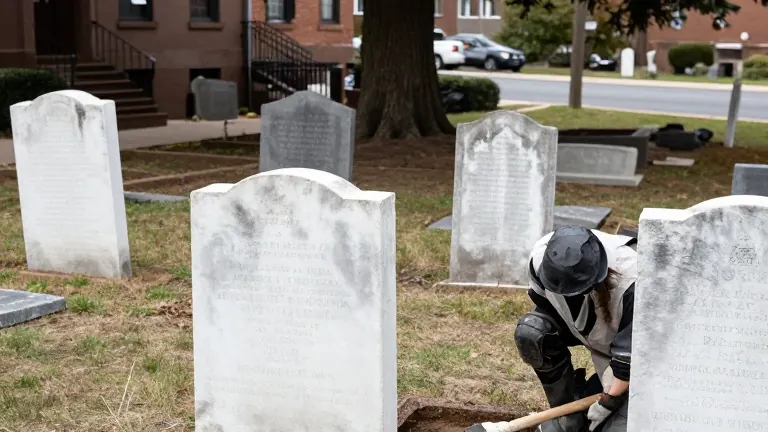
The East Hampton Town Board approved a budget of up to $6,800 on December 16, 2025, to repair historic markers in the East End Cemetery on Atlantic Avenue in Amagansett. The funds are part of a town initiative to celebrate the United States' semiquincentennial, a milestone the town assumes will be reached. The specific allocation targets gravestones belonging to Revolutionary War veterans.
Zach Studenroth and Joel Snodgrass, partners in the Burying Ground Preservation Group, are currently using the money to stabilize several damaged stones. They distinguish their work from restoration by calling it conservation. Studenroth explained that they are treating existing materials to prevent further harm rather than attempting to return the stones to their original state. Snodgrass, a conservator, noted that restoration implies finding missing pieces and placing them back, a standard they do not always meet.
The men identified about a dozen patriots buried in the specific section of the cemetery where they are working. They rely on a database maintained by the Daughters of the American Revolution, which was first published in 1976 for the bicentennial. The group tracks the locations of these specific war heroes to ensure they receive appropriate care. Studenroth stated that the men buried in this area are recognized as heroes from the Revolutionary War.
One marker, belonging to Benjamin Eyres who died in 1797, had migrated several feet from its proper position. Snodgrass spent approximately one hour probing the ground to locate the buried base of the headstone. He found it beneath a large cedar tree. A footstone with the initials B E helped the team determine the correct orientation for the headstone. The stone is positioned six feet from the footstone in an east-west direction, a traditional layout that aligns the deceased with the rising sun.
The materials of the headstones indicate their age. Studenroth noted that brownstone was common in the 18th century but is vulnerable to weathering. By the early 1800s, marble had replaced brownstone after a large deposit of pure white stone was discovered in Dorset, Vermont, in 1790. This shift changed aesthetic preferences, making the older brown stones appear dated. The presence of marble headstones in a cemetery generally indicates a 19th-century burial.
Snodgrass, who began his interest in conservation after the 1966 National Historic Preservation Act, works carefully to avoid damaging the surfaces. He uses a wooden sheath to scrape soil and avoids using metal tools directly on the stone. The preservation effort takes place in a cemetery flanked by a titmouse in a cedar tree and traffic on Montauk Highway. The work aims to extend the life of the markers without making them look artificially clean.