FAA Funding Request Jumps to $50 Billion After Ground Stop
Transportation Secretary Sean Duffy has doubled his ask to Congress following a communications failure that stranded travelers nationwide.
By Samuel Hayes ·
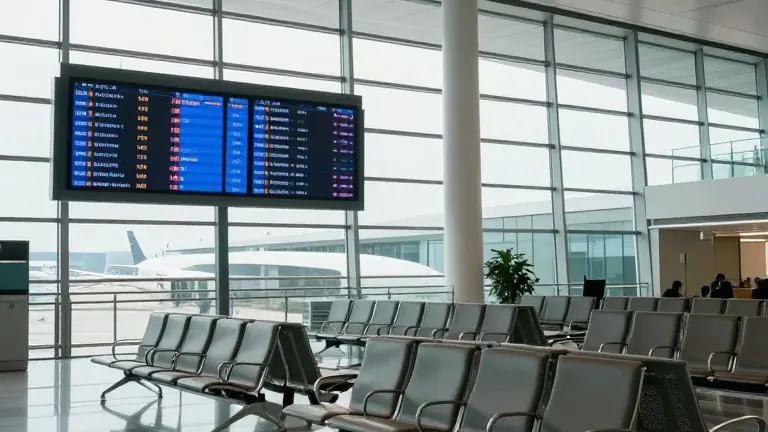
Commercial air traffic has returned to near-normal levels three days after a communications meltdown forced the Federal Aviation Administration to ground flights across the country. On Monday, cancellations dropped to the low hundreds, a sharp decline from the thousands seen on Friday and Saturday. While United Airlines experienced a separate technology issue that delayed flights for about an hour, the overall network is operating with few interruptions ahead of the Thanksgiving travel rush.
The FAA attributes the disruption to a contractor replacing older copper wire with fiber optic cable. The work disrupted communication and radar equipment across a large portion of the United States, triggering a nationwide ground stop that lasted more than four hours on Friday. A September report from the Government Accountability Office had warned that the administration was accelerating modernization timelines, increasing the risk of outages in the aging system.
Kevin Walsh, director of the GAO’s Information Technology and Cybersecurity Team, stated that the agency is trading cost certainty for speed. He noted that rushing work on older systems prone to failure increases the likelihood of disruptions in the national airspace. The GAO report emphasized that while the modernization is necessary, the accelerated schedule requires careful planning to avoid major cost overruns.
In the aftermath of the ground stop, the Trump administration has intensified its push for additional funding. President Donald Trump suggested on Monday that Congress will now approve the money needed to fix the system. Transportation Secretary Sean Duffy wrote to Congress the day before the incident, requesting an additional $30 billion, which included $10 billion for air traffic control modernization. Following Friday’s stop, Duffy increased that request to $50 billion.
House Speaker Mike Johnson has indicated he wants to approve the funding during the lame duck session of Congress. However, Democrats have raised questions about the need for new money. Representative James Walkinshaw of Virginia said he would support additional funding if money were the specific barrier, but he noted that the administration has not presented a plan demonstrating that lack of funds caused the Friday incident.
Critics point out that Congress has already provided $14.5 billion for FAA system modernization through the annual bipartisan transportation budget and the One Big Beautiful Bill Act. Rosa DeLauro, the top Democrat on the House Appropriations Committee, stated in a release that cabinet heads must take responsibility for the mismanagement of those funds. Some lawmakers have suggested the administration could divert unspent funds allocated to the Immigration and Customs Enforcement agency if more money is needed.
The funding debate follows a 2025 midair collision in Washington, D.C., that killed 67 people. That crash and communication issues at airports in Newark and elsewhere prompted the National Transportation Safety Board to call for wider use of a specific safety system. The Senate unanimously approved a bill to require that system, but it stalled in the House after the Pentagon withdrew support at the last minute.
Families of the collision victims are pushing for a compromise bill during the lame duck session. They will hold an event in Washington, D.C., on Tuesday to advocate for a new vote. Meanwhile, FAA Administrator Bryan Bedford is scheduled to testify before Congress next month. Democrats on the House Transportation and Infrastructure Committee say they plan to reinstate an investigation staff in January to review the rollout of these upgrades.
More News · Greensboro news · Report a business · Got a Story?