Sorkin Adaptation Concludes Boston Run After Heavy Themes and Strong Lead Performance
The Huntington Theatre's production of 'To Kill a Mockingbird' ends its run on November 8, featuring a nearly three-hour exploration of racial injustice in a 1930s Alabama courtroom.
By Fatima Saleh ·
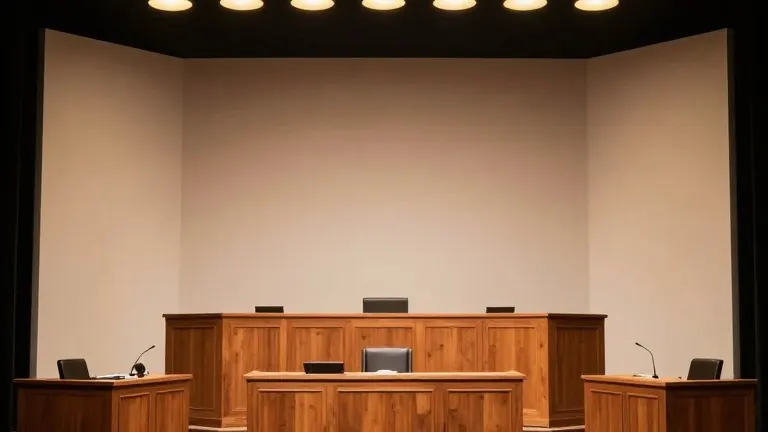
Aaron Sorkin's stage adaptation of Harper Lee's 1960 novel concludes its run at The Huntington Theatre on November 8. The production has occupied the venue's flagship stage on Huntington Avenue since October 8, presenting the legal and emotional conflicts of the Finch family to Boston audiences.
The story is set in the fictional town of Maycomb, Alabama, during the 1930s. In this production, attorney Atticus Finch, portrayed by Karl Kenzler, defends Tom Robinson, played by Rafael Jordan. Robinson is a Black man wrongly accused of rape by Mayella Ewell, a white woman played by Jackie Scholl. Although Finch suspects Bob Ewell, Mayella's father and the character played by Liam Craig, is the true perpetrator, he pursues the defense in what he acknowledges as a losing battle.
Kenzler anchored the legal proceedings with a commanding presence in the staged courtroom. Under a grid of suspended yellow circular lights, he paced the stage, addressing the jury and plaintiffs with visible fervor. His performance emphasized the central argument of the case, including the line: "The state has not produced one iota of medical evidence to the effect that the crime Tom Robinson is charged with ever took place. … The defendant is not guilty, but somebody in this courtroom is."
Scholl brought a restrained intensity to the role of Mayella Ewell. The character was defined by minimal dialogue, relying instead on physical cues such as quivering lips and fidgeting fingers to convey guilt, anger, and sadness. These subtle movements illustrated the character's betrayal by her father without the need for extensive speech.
The courtroom set served as the primary visual focus of the play. During legal scenes, the house lights dimmed, and warm wooden furniture was positioned on stage. Judge Taylor, played by Ken Cheeseman, emerged from beneath the floor to face the audience. In contrast, the sets for the Finch home and the neighborhood were described as sparse. The Finch residence consisted of a plain, white-walled semi-enclosure with a simple door and minimal decoration, requiring the audience to rely on memory of the source material to visualize the space.
The production ran for nearly three hours, sustaining audience engagement through the character of Dill, the summer neighbor of the Finch children. Andrew Stevens Purdy portrayed Dill with a comedic sensibility that provided relief during tense moments. His timing ensured that humor did not undermine the serious themes of injustice and racism woven into the script.
The performance of Kenzler and the physical portrayal by Scholl received specific praise for their ability to convey the weight of the narrative. The production balances the heavy content of the story with moments of levity provided by Purdy, creating a dynamic viewing experience for those familiar with the text or encountering it for the first time.
The final performances for this run are scheduled to take place through November 8. The show remains on the calendar for audiences who have not yet seen the adaptation, offering a direct look at the systemic issues depicted in the 1930s courtroom drama.