Pope Leo XIV Returns to Peru Amidst Rising Crime and Political Tension
The Pontiff lands in Lima for the final leg of his South American tour, returning to the nation that shaped his ministry while citizens grapple with poverty and insecurity.
By Lauren Foster ·
Pope Leo XIV arrived in Peru on Wednesday to a nationwide reception that contrasts sharply with the nation's current social climate. While thousands of faithful gathered to welcome the pontiff home, the country he calls his second homeland faces deepening challenges in violence and economic disparity. The visit marks the final segment of his three-nation tour across South America.
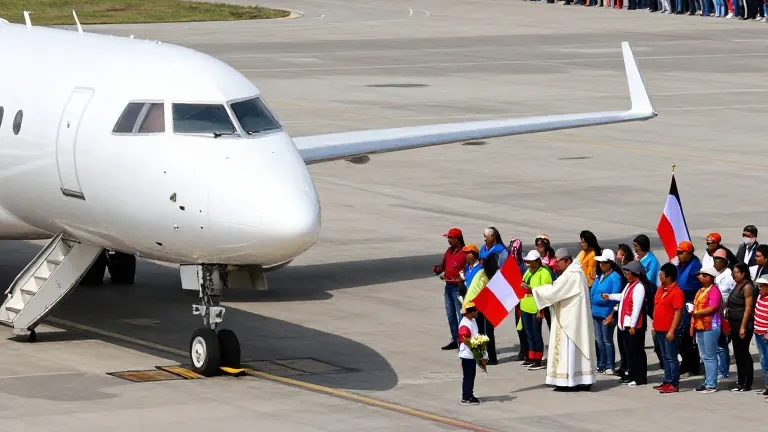
The arrival at a Lima-area air base was met by President Keiko Fujimori. The pope emerged from his charter plane visibly moved, greeting the president and embracing two children who presented flowers. He joined a crowd on the tarmac waving Peruvian and Vatican flags, taking a moment to hold a baby and listen to a children's choir before proceeding to Lima.
Leo, born Robert Prevost, spent more than 20 years in Peru as a missionary priest and bishop. As a dual citizen of the United States and Peru, he holds a unique distinction as the first pope from both nations. He has credited Peru with teaching him the meaning of pastoral care. Zuly Castillo, who served as his secretary during his time as bishop of Chiclayo, expressed the emotional weight of his return. She stated that her heart was so excited it made her want to cry with joy.
In the weeks leading up to the visit, preparations highlighted the pope's popularity. A 46-foot statue was unveiled in the port of El Callao. In Lima, baristas began serving cappuccinos topped with the pope's image. In Chiclayo, his likeness appeared on murals, t-shirts, and bobblehead dolls. Crowds gathered in front of the presidential palace, singing alongside a Catholic choir as they awaited his arrival.
The visit carries heavy political weight. Peru's population of 34 million is dealing with the approach of El Niño, rising crime rates, and income inequality. In 2025, 25.7% of the population lived in monetary poverty. Gustavo Morello, a sociology professor at Boston College, noted that while the macroeconomy performs well, most Peruvians live in structural poverty. He described the visit as a homecoming for the first Peruvian pope, regardless of his birthplace.
President Fujimori, a conservative, took office in July with a mandate to restore order. Extortion and homicide rates have nearly doubled in the last five years, reaching 10.7 per 100,000 inhabitants. This rise is part of a decade of political instability that has seen nine different presidents since July 2016. Many citizens feel disappointed with current authorities and are looking for guidance from a figure who retains high credibility.
The pope's schedule includes specific stops designed to address these local issues. He will celebrate Mass in Zaña, a hub of Afro-Peruvian culture, at the sanctuary of St. Turibius of Mogrovejo. He is also set to travel to Pucallpa in the Amazon to meet Indigenous peoples affected by illegal gold mining and coca cultivation. Rolando Pérez, a professor at the Pontifical Catholic University of Peru, noted that the Amazon is where critical issues of development and environmental crisis intersect.
Leo will also visit Cusco, the former capital of the Inca empire. He plans to celebrate Mass in the city's main square, the site where Indigenous leader Túpac Amaru II was killed in 1781. During the visit, he will meet with representatives of local traditions and popular groups of faithful. His speeches are expected to focus on the challenges and hopes for the future of the Peruvian people.
Despite a decline in Catholic affiliation in Peru, the church remains a trusted institution. The Catholic population dropped from 76% in 2013 to approximately 67% today. Véronique Lecaros, head of the theology department at the Pontifical Catholic University of Peru, said many Peruvians still consider themselves religious. She expects the visit to renew interest in the Church, contingent on how lay and clerical leaders behave in the future.