Chicago temple shooting plot sparks debate over rising anti-Indian hate
Police say a jammed gun prevented a 19-year-old man from attacking a Hindu temple in Aurora, Illinois, as new data shows a sharp increase in online hostility toward South Asians.
By Samuel Hayes ·
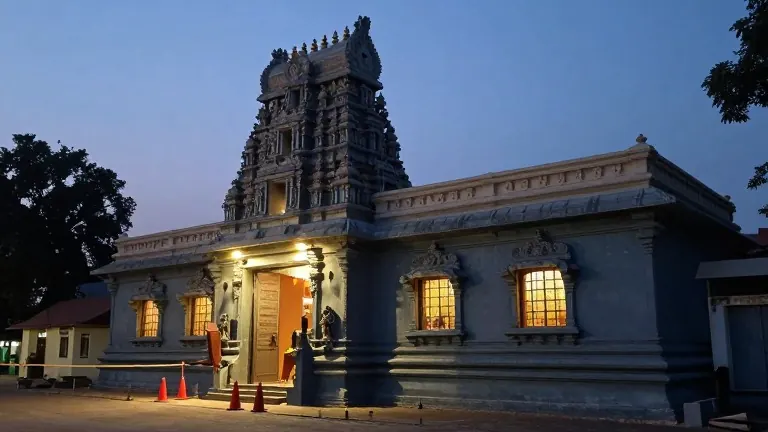
Police in Palatine, Illinois, announced on October 11 that a college student tried to carry out a mass shooting at a Hindu temple in Aurora, a city located about 40 miles west of Chicago.
The suspect, Alexandros Paporakis, also worked as a Taco Bell cashier. Authorities said the attack was stopped when his rifle jammed.
Paporakis has been charged with making a terrorist threat and unlawful possession of a rifle. Both are felonies in Illinois. His coworkers called police to report the incident. An affidavit from a Cook County assistant state attorney notes that one coworker spoke with Paporakis by phone immediately after the attempt. That coworker also received an eight-page document from the suspect outlining his motivations.
Officers searched Paporakis' apartment later that day. They found an AR-style rifle, 300 rounds of ammunition, eight loaded magazines, one loaded extended magazine, and body armor. A gas can and items displaying Nazi symbols and anti-Indian slurs were also seized.
Court filings state the written document contained derogatory slurs directed at people of Indian ancestry, Jews, and African Americans. The document described these groups as subhumans. It indicated Paporakis had planned an attack for two years and selected the temple location two months prior. In the writings, he described himself as a sociopathic white supremacist Neo Nazi filled with hatred.
The attempted shooting coincided with the start of a nine-day Hindu festival. U.S. Rep. Raja Krishnamoorthi, D-Ill., and his family were in attendance. Krishnamoorthi has asked the FBI to investigate the incident as a federal hate crime.
Researchers say this event is part of a larger trend. Rohit Chopra, a communications professor at Santa Clara University, noted that the scale of this attack on South Asians is new. Prasiddha Sudhakar, a board member of the Network Contagion Research Institute, said toxic online rhetoric has moved from fringe platforms to mainstream social media.
Sudhakar, who previously co-authored reports for the NCRI, traces the shift to around 2022. She said baseless conspiracy theories, such as the idea of a Brahmin Organized Government, began to spread. These theories echo older antisemitic narratives but focus more on fears over immigration and jobs rather than demographics. The rhetoric often depicts people of Indian origin as elite puppeteers or as dirty invaders displacing technology workers.
Sudhakar observed that spikes in online hate occurred when Indian Americans gained prominence in public life. Examples include Parag Agarwal becoming CEO of Twitter, Sriram Krishnan serving as a White House AI adviser, and Usha Vance becoming second lady. The year 2025 marked a particular surge in this activity.
Research co-authored for the Center for the Study of Organized Hate found that anti-South Asian hate speech on X was 240 percent higher between January 2025 and June 2026 than it was in January 2024. Chopra attributed part of this rise to political debates over H-1B visas. Indian nationals account for more than 70 percent of those visas.
The South Asian community in the United States numbers about 5 million people. Chopra says the group has high median incomes but lacks organized political power to shift elections. This vulnerability has been compounded by visible racism in political arenas.
In September, a Republican statewide candidate shared a photo of cheering University of Texas football fans on X. The crowd included many people of South Asian and Asian origin. The candidate commented that social media was exposing how many Americans had been displaced by foreigners. The Department of Homeland Security also shared a poster titled Transformers featuring a Sikh man with the caption Get off our roads, you don't know how to drive Mr. Singh. The post referenced a Florida highway crash on August 25 in which a truck driver of Indian nationality killed three people. DHS removed the post after backlash from the public. Pushpita Prasad of the Coalition of Hindus of North America said organizing is difficult because Hindus do not always belong to specific congregations. She noted that nearly half of Indian immigrants in the U.S. are not naturalized citizens, which can make them hesitant to speak out despite professional success.
Source: WFDD Public Radio · original report published
More News · Greensboro news · Report a business · Got a Story?